
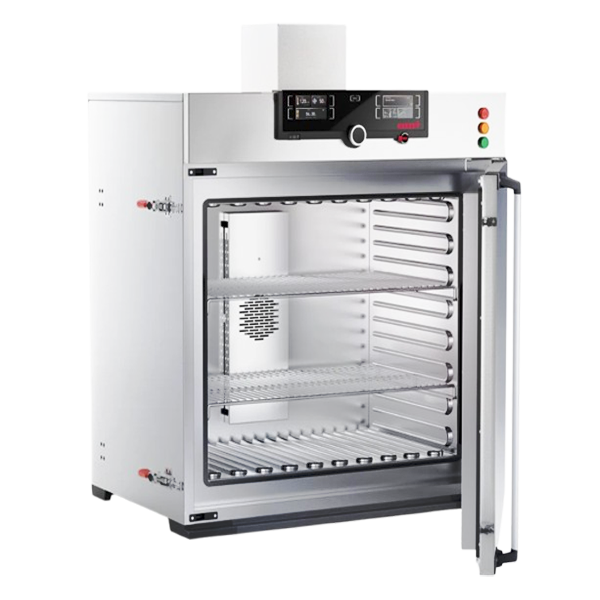
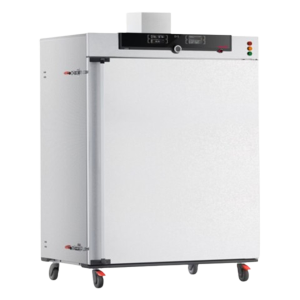
Battery test chamber
Designed for thermal battery testing.
Engeneered for safety in applications up to hazard level 4.
The Memmert U-BTC battery test chamber was specifically developed for thermal battery testing up to Hazard Level 4, combining precise temperature control with integrated safety features for reliable test conditions.
MEMMERT U‑BTC Battery Test Chamber
Models:
UN‑BTC 110
UN‑BTC 160
UN‑BTC 250
UN‑BTC 260
UN‑BTC 400
UN‑BTC 450
UN‑BTC 750
Features
- Designed specifically for battery testing up to Hazard Level 4
- Temperature range: +20°C to +120°C
- Suitable for testing battery cells, modules, and complete battery systems
- Supports development, validation, and quality assurance applications
- Complies with battery testing requirements including IEC 62660, IEC 62619, and ISO 12405‑4
- Integrated pressure relief system
- Mechanical door locking system
- Process-dependent electronic door locking
- Door-open detection system
- Nearly gas-tight chamber interior
- Signal lights indicating operating status
- Temperature limitation to +120°C for enhanced safety
- Uniform and precise thermal conditions for battery testing
- Designed for demanding safety applications without requiring optional safety upgrades
Description
MEMMERT U‑BTC Battery Test Chamber
Designed for thermal battery testing up to Hazard Level 4, the Memmert U‑BTC Battery Test Chamber combines precise temperature control with integrated safety features to provide reliable and reproducible test conditions for battery cells, modules, and complete battery systems.
The Memmert U‑BTC was specifically developed for thermal testing of lithium-ion batteries and energy storage systems. It supports battery development, validation, quality assurance, and compliance testing according to standards such as IEC 62660, IEC 62619, and ISO 12405‑4.
Designed with an integrated safety concept, the U‑BTC provides safe operation during elevated-temperature battery testing while reducing risk in critical test scenarios. The chamber covers a temperature range from +20°C to +120°C, making it suitable for a wide variety of battery testing procedures.
Designed for safe battery testing
Why it matters
Battery testing requires more than precise temperature control. Heat generated by the battery, the test procedure and potential failure scenarios all need to be considered when creating a reliable test environment.
Designed specifically for thermal battery testing up to Hazard Level 4, the U-BTC provides reliable conditions for testing at elevated temperatures.
Its temperature ranges from +20 to +120 °C covers a wide range of thermal battery testing requirements.
Its integrated safety concept combines pressure relief, mechanical door locking and process-dependent electronic locking.
For your battery testing
The U-BTC is designed for thermal battery testing from individual cells to complete battery systems. It supports a wide range of applications in development, validation and quality assurance, including test tasks related to standards such as IEC 62660, IEC 62619 and ISO 12405-4.
Typical users
- Battery cell manufacturers
- Automotive OEMs and suppliers
- Energy storage providers
- Test laboratories
- Research institutions
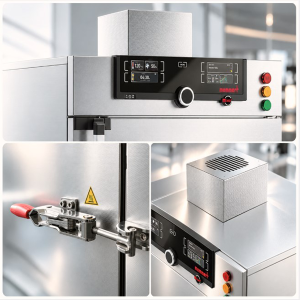
Safety Features Come Standard
- Key battery-specific safety features are built in from the start and require no separate configuration or ordering.
- Pressure relief
- Mechanical door locking
- Process-dependent electronic locking
- Door-open recognition
- Interior nearly gastight
- Signal lights for device status
- Temperature restriction to +120 °C
Each U-BTC model size is available as UN-BTC with natural convection or as UF-BTC with forced air circulation.
Specifications
| Model | Volume | Internal Dimensions (W × H × D) | External Dimensions (W × H × D) | Max. Chamber Load |
| UN‑BTC 110 | 108 L | 560 × 480 × 400 mm | 745 × 864 × 584 mm | 175 kg |
| UN‑BTC 160 | 161 L | 560 × 720 × 400 mm | 745 × 1104 × 584 mm | 210 kg |
| UN‑BTC 250 | 256 L | 800 × 640 × 500 mm | 984 × 1023 × 684 mm | 300 kg |
| UN‑BTC 260 | 256 L | 640 × 800 × 500 mm | 824 × 1183 × 684 mm | 300 kg |
| UN‑BTC 400 | 384 L | 640 × 1200 × 500 mm | 824 × 1720 × 684 mm | 300 kg |
| UN‑BTC 450 | 449 L | 1040 × 720 × 600 mm | 1224 × 1247 × 784 mm | 300 kg |
| UN‑BTC 750 | 749 L | 1040 × 1200 × 600 mm | 1224 × 1720 × 784 mm | 300 kg |
Standards in Focus
The U-BTC supports typical thermal test tasks in the context of relevant battery standards. Which test procedures can be supported in a specific application depends on the battery under test, the required test conditions and the selected U-BTC model.
The Eucar Hazard Levels
Hazard Levels indicate how a battery may react during testing. The Memmert U-BTC is designed for applications up to Hazard Level 4 and must not be used for applications at Hazard Level 5 or higher.
Hazard
level Description Effect on the battery cell Visual / acoustic alarm Temperature limiter
Tmax Electrical door lock Mechanical door securing Reversible pressure relief flap Fire detection
CO₂ measurement CO₂ / N₂ purging system Continuous N₂ inerting / O₂ measurement Overpressure relief / rupture disc
0 No effect No effect.
No impairment of functionality. ☒
1 Protection system
activates No defect. Cell recoverable; protection
system repair required. ☒ ☒
2 Defect, damage Cell damaged. Repair required. ☒ ☒ ☒
3 Leak,
mass loss < 50% Electrolyte loss, no venting,
no flame or fire. ☒ ☒ ☒ ☒
4 Gas release,
mass loss > 50% Electrolyte loss, cell venting,
no flame or fire. ☒ ☒ ☒ ☒ ☒
5 Fire or flame No rupture, no explosion, no flying parts. □ □ □ □ □ □ □
6 Rupture No explosion, no flying parts. □ □ □ □ □ □ □ □
7 Explosion Explosion, destruction within a very
short time □ □ □ □ □ □ □ □ □
Full visibility at all times
For connected processes, the U-BTC can be integrated into the digital Memmert myChamber ecosystem. This brings digital functions for monitoring, device management and documentation into the testing process.
Download Brochure


Reviews
There are no reviews yet.