
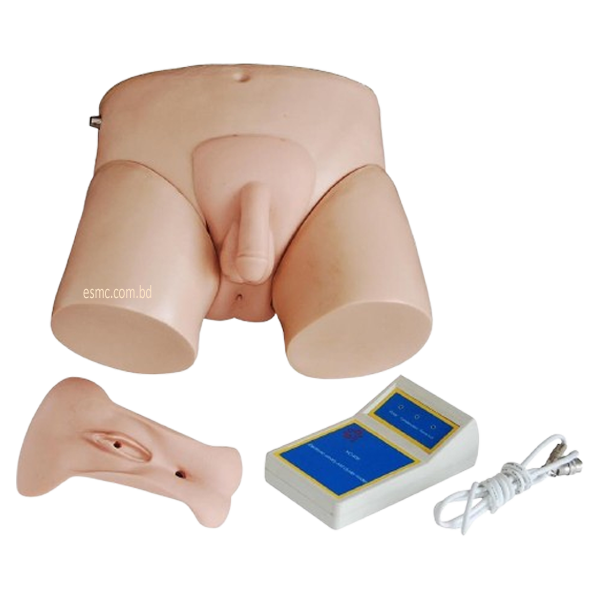
This model can be demonstrated some functions: catheterization of male, catheterization of female and intestinal irrigation etc. Packing: 1pcs/ctn, 52x30x40cm,7kgs
Introduction
XC-408 Electronic Urinary Model – Practical Medical Training Solution
The XC-408 Electronic Urinary Model is a professional medical education and nursing training model designed to provide students with a more practical understanding of the human urinary system. Procedures related to the urinary system are an essential component of nursing education, clinical skills training, and patient care. Therefore, beyond mere textbook knowledge, visual and hands-on learning opportunities are crucial for students.
This model enhances the effectiveness of classroom instruction regarding the basic structure of the urinary system and urinary care procedures. Instructors can use the model to provide step-by-step demonstrations, while students can observe the procedures closely and practice under supervision.
The XC-408 Electronic Urinary Model is suitable for nursing schools, medical colleges, paramedical institutes, healthcare training centers, and clinical skills laboratories. It serves as an effective teaching aid for both anatomical education and the development of practical nursing skills.
Learning About the Human Urinary System
The human urinary system is closely linked to the body’s waste management and fluid balance. The kidneys, ureters, urinary bladder, and urethra are key components of this system. For students, grasping the interrelationships between these structures forms an essential foundation for clinical education.
In traditional textbook-based learning, students often struggle to fully comprehend the three-dimensional relationships of anatomical structures. A physical training model provides a more direct visual reference.
With the XC-408 Electronic Urinary Model, educators can explain urinary anatomy in a more interactive way. Students can identify the relevant structures and gain a clear understanding of how the various parts of the urinary tract are connected.
Practical Training for Nursing Students
In nursing education, urinary care is an important clinical skill area. It is essential to have proper knowledge of urinary catheterization, urinary drainage, and related nursing procedures when providing patient care.
The model can be incorporated into supervised practical classes where instructors explain appropriate procedure steps, infection-control considerations, patient communication and safe handling principles.
Students can first observe the instructor and then perform practice according to their institutional training protocol. This approach helps bridge the gap between theoretical learning and clinical skill practice.
Catheterization Training Support
Urinary catheterization is a common clinical procedure that requires proper anatomical understanding, technique and infection-control practice. XC-408 Electronic Urinary Model can be used as a training aid for demonstrating catheter-related concepts in a controlled educational environment.
Students can learn the importance of:
- Proper anatomical identification
- Correct preparation before procedure
- Appropriate equipment handling
- Maintaining aseptic technique
- Proper procedural sequence
- Patient privacy and communication
- Safe removal and aftercare principles
However, before performing procedures on actual patients, students must ensure they are under the supervision of a qualified instructor and follow institution-approved clinical protocols.
Electronic Training Advantage
The electronic functionality of the XC-408 Electronic Urinary Model can make practical teaching more engaging than static anatomy charts. Electronic training features can help instructors demonstrate selected functions in a controlled classroom or laboratory setting.
This type of model is especially useful where institutions want to create a dedicated simulation-based learning environment. Students can repeatedly observe and practice educational scenarios without using a real patient during the initial training stage.
A major advantage of simulation-based learning is that students can identify and correct mistakes within a controlled environment. This can improve familiarity with the procedure before they progress to supervised clinical practice.
Medical College and Nursing Institute Use
The XC-408 Electronic Urinary Model can be useful in several educational environments, including:
- Nursing colleges
- Medical colleges
- Nursing training institutes
- Paramedical institutes
- Allied health training centers
- Clinical skills laboratories
- Healthcare education centers
- Hospital training departments
Instructors can integrate the model into anatomy classes, nursing procedure demonstrations, OSCE preparation and clinical skills sessions.
Student-Friendly Learning
A good training model should be easy for students to observe and understand. The physical representation of the urinary system helps students connect textbook diagrams with practical anatomical concepts.
For beginner-level learners, teachers can start with basic identification of the urinary organs. Later, they can introduce more advanced topics such as urinary catheterization, urinary drainage and nursing care principles.
This progressive learning method is easier for students because they learn from simple anatomy identification to practical procedure concepts step-by-step.
Use in Demonstration Classes
Teachers can use XC-408 Electronic Urinary Model during group demonstrations. One instructor can demonstrate the procedure while multiple students observe from a suitable distance.
After demonstration, students can participate in supervised practice sessions. This makes the classroom more interactive and allows instructors to identify common mistakes.
For examination preparation, the model can also be incorporated into practical assessment stations. Students may be asked to identify structures, explain procedure steps or demonstrate selected skills according to their curriculum.
Clinical Skills Development
Clinical skills development requires repeated practice. A simulation model gives learners an opportunity to become familiar with instruments, positioning and procedural sequence before working with real patients.
The XC-408 Electronic Urinary Model can therefore support a structured training workflow:
Theory → Demonstration → Supervised Practice → Feedback → Repeated Practice → Clinical Application
This approach can help students develop procedural familiarity and confidence.
Importance of Infection Control Education
Urinary procedures require particular attention to infection prevention. During training, instructors can emphasize hand hygiene, appropriate PPE, sterile/aseptic technique where applicable, equipment preparation, proper disposal and environmental hygiene.
The model should be used as part of a complete clinical-skills curriculum rather than as a replacement for professional instruction.
Students should learn not only how a procedure is performed, but also why each infection-control step is important.
Suitable for Bangladesh Medical Education
Practical training equipment is becoming increasingly important for nursing colleges, medical training centers, and healthcare education institutes in Bangladesh. The XC-408 Electronic Urinary Model can be utilized as part of a dedicated simulation laboratory setup.
In a bilingual (English and Bangla) classroom environment, instructors can easily explain medical terminology in English while clarifying practical concepts in Bangla. This makes the learning process more accessible for students.
Benefits of XC-408 Electronic Urinary Model
The major educational benefits include:
- Practical urinary anatomy learning
- Improved visual understanding
- Demonstration of urinary care concepts
- Catheterization training support
- Repeated simulation practice
- Classroom demonstration capability
- Nursing skills laboratory application
- Student confidence development
- Instructor-led practical teaching
- Controlled learning environment
Why Use a Urinary Training Model?
Simulation-based learning is a useful educational approach before real-patient training. Students first learn the relevant anatomy and procedure in a controlled environment, receive instructor feedback, and gradually progress toward supervised clinical application.
A physical urinary model also provides a consistent teaching platform. Training of different batches of students can be conducted with the same model.
For institutions, this can be useful for maintaining a structured practical teaching environment.
Recommended Training Approach
For effective use, instructors can divide training into several stages.
Stage 1 – Anatomy:
Students identify the major urinary structures.
Stage 2 – Theory:
Teacher explains the function and clinical importance of the urinary system.
Stage 3 – Demonstration:
Instructor demonstrates the relevant procedure using the model.
Stage 4 – Practice:
Students perform supervised practice according to their curriculum.
Stage 5 – Feedback:
Instructor identifies technical mistakes and explains corrections.
Stage 6 – Assessment:
Students demonstrate the acquired skill independently under supervision.
This approach can help improve the quality of practical learning.
Maintenance and Care
Proper handling is essential to maintain the long-term usability of a training model. After use, the model should be cleaned, dried, and stored in a protected environment. If the model contains electronic components, the manufacturer’s recommended handling and cleaning procedures must be followed.
Excessive force should not be applied to the model. When using training instruments, one must adhere to institution-approved procedures and the manufacturer’s instructions.
Ideal for Medical Education Suppliers
XC-408 Electronic Urinary Model is a relevant training product for medical equipment suppliers, nursing education suppliers, hospital training departments and institutional procurement.
Educational institutions can use this model according to their practical laboratory requirements. For procurement, buyers should confirm available specifications, included accessories, electronic functions and warranty/service terms with the supplier before purchase.
Specifications
| Product Model | XC-408 |
| Product Name | Electronic Urinary Model |
| Product Type | Medical Training Simulator |
| Training Area | Urinary System / Nursing Skills |
| Main Application | Medical & Nursing Education |
| Training Purpose | Urinary System and Procedure Demonstration |
| Learning Method | Practical / Simulation-Based Training |
| Suitable Users | Medical & Nursing Students |
| Suitable Institutions | Medical Colleges, Nursing Colleges, Training Centers |
| Demonstration | Instructor-Led Practical Demonstration |
| Training Level | Basic to Intermediate, according to curriculum |
| Electronic Feature | Electronic training functionality |
| Material | Medical Training Model Construction |
| Application | Anatomy, Nursing and Clinical Skills Training |
Note: Exact dimensions, power requirements, included accessories, electronic functions and package contents may vary by manufacturer/version. Please confirm the current supplier specification before purchase.
Key Features
- Professional XC-408 Electronic Urinary Model
- Designed for medical and nursing education
- Useful for urinary system teaching
- Supports practical demonstration
- Suitable for catheterization-related training
- Helps students understand urinary anatomy
- Useful for clinical skills laboratory
- Supports repeated simulation practice
- Suitable for instructor-led teaching
- Appropriate for nursing and medical training institutions
- Helps connect theoretical knowledge with practical learning
- Suitable for Bangladesh healthcare education environments
Applications
XC-408 Electronic Urinary Model can be used for:
- Nursing practical classes
- Medical anatomy education
- Urinary system demonstration
- Clinical skills laboratory
- Catheterization training
- Nursing procedure practice
- OSCE preparation
- Healthcare assistant training
- Paramedical education
- Instructor-led simulation training
Frequently Asked Questions (FAQ)
- What is the XC-408 Electronic Urinary Model?
The XC-408 Electronic Urinary Model is a medical training simulator designed for teaching urinary anatomy and related nursing and clinical procedure concepts.
- Who can use the XC-408 model?
It is suitable for nursing students, medical students, paramedical students, healthcare trainees and instructors in educational institutions.
- Can it be used for catheterization training?
Yes. The model can be used as a training aid for demonstrating urinary catheterization-related concepts and supervised practical learning, depending on the model configuration.
- Is the XC-408 suitable for nursing colleges?
Yes. It can be incorporated into nursing skills laboratories and practical demonstration classes.
- Can teachers use this model for classroom demonstration?
Yes. Instructors can use the model to explain urinary anatomy and demonstrate selected clinical skills in a controlled educational environment.
- Is this a real-patient replacement?
No. It is a training simulator. Students should progress to real-patient clinical practice only under qualified supervision and according to institutional protocols.
- What subjects can be taught with this model?
It can support urinary anatomy, urinary care, catheterization-related training, clinical skills and practical nursing education.
- Is it suitable for OSCE preparation?
The model may be incorporated into OSCE-style practice stations for relevant urinary-system skills according to the institution’s curriculum.
- Where can the XC-408 Electronic Urinary Model be used?
It can be used in medical colleges, nursing colleges, paramedical institutes, clinical skills laboratories, hospitals and healthcare training centers.
- Why use a urinary simulation model?
A simulation model allows students to practice and observe procedures in a controlled environment before progressing to supervised clinical practice.
Conclusion
XC-408 Electronic Urinary Model is a practical educational solution for institutions that want to provide students with hands-on urinary system and clinical skills training. By combining anatomical understanding with simulation-based learning, it can support nursing, medical and paramedical education in a structured classroom or skills-laboratory environment.
*Images are reference only. Actual product may be different.
Stay in Touch
Elite Scientific & Meditech Co. is the best seller & Supplier in Bangladesh. Click Our Social Site, Facebook, LinkedIn, Twitter, Instagram, YouTube. Only Back order product available. Exact technical specifications and included accessories should be confirmed with Elite Scientific & Meditech Co. Before purchase. Features may vary according to the manufacturer and supplied configuration.
Download Catalogue
Electronic Urinary Model, XC-408, Xincheng, China
Demo Video



Reviews
There are no reviews yet.