
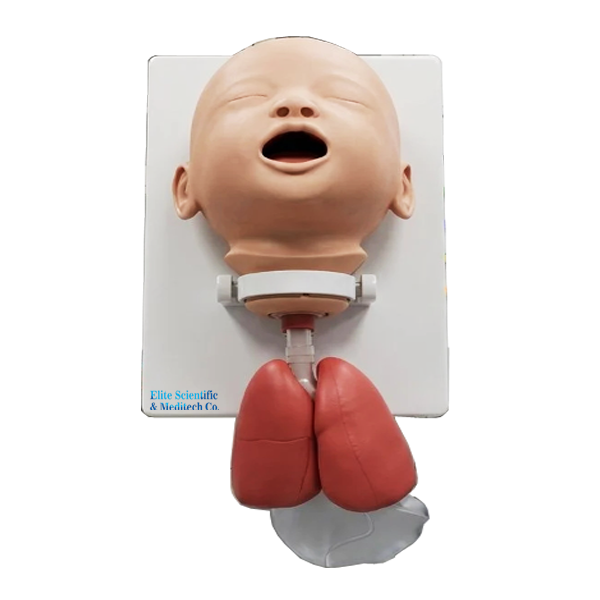
Realistic anatomical structure of infant mouth, pharynx, trachea. Tracheal intubation, directly observe the expansion of lungs and stomach by insufflating air into the tube and stomach so as to verify if the tube position is correct. Packing: 1pcs/carton, 37x20x27cm, 3kgs
Description
XC-410A Infant Intubation Training Model
The XC-410A Infant Intubation Training Model is a specialized simulation tool designed for practical training in infant airway management and tracheal intubation. Infant airway management is a specialized clinical skill that requires a thorough understanding of anatomy, proper technique, and careful procedural training.
While airway procedures can be studied through textbooks or lectures, practical simulation helps learners develop hands-on familiarity with these procedures. The XC-410A can be used to create a controlled training environment for this purpose.
Available product descriptions indicate that the model has realistic anatomical structures of the infant mouth, pharynx and trachea. It also supports tracheal intubation practice and allows direct observation of lung and stomach expansion when air is insufflated through the tube, which can help learners verify tube positioning during simulation.
Realistic Infant Anatomy
A practical understanding of infant airway anatomy is an important component of healthcare education. The XC-410A model features a realistic structure of an infant’s mouth, pharynx, and trachea, allowing instructors to demonstrate relevant airway anatomy to learners.
During classroom sessions, instructors can use the model to:
- Explain the anatomy of an infant’s mouth
- Demonstrate the position of the pharynx
- Explain the location of the trachea
- Show the relationship between the airway and the intubation procedure
- Allow students to observe the anatomical structures
This enables students to gain a practical grasp of anatomy through a physical model, complementing the information provided by diagrams or textbook images.
Infant Tracheal Intubation Training
Tracheal intubation is a clinical procedure that requires appropriate professional training and supervision. Learners can practice their initial skills in a controlled environment using a simulation model.
The XC-410A Infant Intubation Training Model is designed for practicing tracheal intubation. An instructor can first explain the educational principles of the procedure and then facilitate supervised practice.
A typical training session might look like this:
- Introduction to infant airway anatomy
- Basic orientation to intubation equipment
- Instructor demonstration
- Supervised practice of tube placement
- Verification of tube position
- Observation of performance
- Instructor feedback
- Repeated practice
This structured approach can help learners develop procedural familiarity.
Lung & Stomach Expansion Observation
A notable training feature of the XC-410A is that the expansion of the lungs and stomach can be directly observed during air insufflation via a tube. According to catalogue descriptions, this feature can be utilized in educational exercises to verify whether the tube is correctly positioned.
It provides a practical visual feedback mechanism for learners.
Instructors can explain how the expansion observed after tube placement in the training simulation relates to the educational context of assessing tube positioning.
This can be particularly useful for:
- Airway training
- Intubation demonstration
- Skills assessment
- Student practice
- Instructor feedback
- Simulation-based learning
For Medical Students
Medical students may require practical learning in addition to theoretical knowledge regarding pediatric and infant airway management.
Using the XC-410A, medical instructors can demonstrate infant airway anatomy and intubation procedures.
Through supervised simulation, students can:
- Can observe infant airway anatomy
- Can learn the sequence of the intubation procedure
- Can practice tube placement
- Can observe lung/stomach expansion
- Can receive feedback from an instructor
This hands-on learning can help connect classroom theory with practical simulation.
For Nursing Students
In nursing education, infant and pediatric emergency care is a vital area of training. Developing a basic, practical familiarity with airway management can be highly beneficial for nurses and nursing students, depending on their specific clinical roles and the scope of their training.
An infant intubation training model can be utilized for instructor-led airway education within a nursing skills laboratory.
Through such a model, students can gain hands-on experience with infant airway anatomy and the educational procedures related to intubation.
Pediatric & Neonatal Training
An infant-focused training model is particularly relevant for pediatric and neonatal healthcare education. Although “infant” and “newborn” refer to distinct age categories, age-specific airway simulation allows learners to practice within appropriate clinical scenarios.
Designed for infant airway training, the XC-410A model is suitable for use in pediatric clinical skills laboratories.
In pediatric training programs, instructors can use this model to explain concepts such as airway anatomy, intubation procedures, and the verification of tube placement.
Hospital Training
Simulation equipment can be used for staff education and refresher training in hospital-based clinical skills centers.
Infant airway training sessions can be organized using the XC-410A. Instructors can conduct demonstrations and oversee practice sessions based on specific training scenarios.
Potential applications include:
- Paediatric skills training
- Infant airway education
- Staff refresher sessions
- Simulation workshops
- Clinical skills demonstrations
- Healthcare trainee education
Simulation Laboratory
A medical simulation laboratory provides a controlled practice environment that allows learners to acquire clinical procedures.
The XC-410A Infant Intubation Training Model can be used in a simulation lab alongside other pediatric and neonatal training models.
Instructors can facilitate scenario-based learning, in which students:
- Identify anatomy
- Observe procedures
- Practice intubation
- Verify tube placement
- Engage in further practice based on feedback
This approach can help make practical skills education more structured.
Practical Learning & Repeated Practice
Repeated practice is essential for learning procedures such as infant intubation. Simulation models provide learners with the opportunity for repeated practice in a supervised environment.
A training workflow:
Step 1: The instructor explains the anatomy of an infant’s airway.
Step 2: The instructor demonstrates the intubation procedure.
Step 3: The trainee practices the procedure.
Step 4: Observations regarding the position of the tube are made.
Step 5: The instructor reviews the performance.
Step 6: Corrections are provided as needed.
Step 7: The trainee practices again.
This cycle can help learners develop procedural familiarity and confidence in their training.
Key Features
- Infant-specific intubation training model
- Realistic infant mouth anatomy
- Realistic pharynx structure
- Realistic trachea structure
- Designed for tracheal intubation practice
- Allows observation of lung expansion during simulation
- Allows observation of stomach expansion during simulation
- Supports tube-position verification exercises
- Suitable for hands-on training
- Useful for medical education
- Suitable for nursing education
- Useful for pediatric airway training
- Suitable for simulation laboratories
- Supports instructor-led demonstration
The above anatomical and functional features are based on available product catalogue descriptions.
Applications
The XC-410A Infant Intubation Training Model can be used for:
- Medical colleges
- Nursing colleges
- Pediatric skills laboratories
- Hospital training centers
- Medical simulation laboratories
- Nursing skills laboratories
- Pediatric airway training
- Infant intubation education
- Clinical skills demonstrations
- Healthcare professional training
- Paramedical education
- Emergency care education
- Simulation-based workshops
- Airway management courses
- Practical medical training
Benefits
Realistic Anatomy
The realistic anatomical structure of an infant’s mouth, pharynx, and trachea helps learners understand airway anatomy.
Practical Intubation Training
Learners can practice the tracheal intubation procedure in a supervised environment.
Visual Verification
During air insufflation, the expansion of the lungs and stomach can be observed, which can be used for training exercises focused on verifying tube placement.
Repeated Practice
Students can practice the procedure repeatedly and receive feedback from an instructor.
Controlled Learning
Initial procedural learning can be conducted using a simulation model rather than a real patient.
Suitable Users
Medical Students
For infant airway anatomy and intubation training.
Nursing Students
For pediatric and infant airway education.
Pediatric Healthcare Trainees
For infant airway management simulation.
Paramedical Students
For relevant emergency airway training.
Clinical Instructors
For demonstration, practice, and skills training.
Hospital Training Centers
For staff education and simulation-based clinical skills training.
Specifications
| Model | XC-410A |
| Product Name | Infant Intubation Training Model |
| Product Type | Infant Airway & Intubation Training Model |
| Anatomical Structures | Infant Mouth, Pharynx & Trachea |
| Main Application | Tracheal Intubation Training |
| Training Feature | Lung & Stomach Expansion Observation |
| Tube Verification | Visual Verification Through Simulated Expansion |
| Suitable For | Medical & Nursing Education |
| Users | Medical Students, Nurses, Healthcare Trainees |
| Training Method | Simulation-Based Hands-on Practice |
| Application Environment | Medical College, Hospital, Skills Lab |
| Category | Medical Simulation Equipment |
| Packing | 1 pc/carton |
| Packing Size | Approx. 38 × 20 × 28 cm |
| Packing Weight | Approx. 3 kg |
The catalogue sources list the packing as 1 pc/carton, approximately 38 × 20 × 28 cm and 3 kg. Confirm final packing/specifications with the supplier before purchase.
Why Use an Infant Intubation Training Model?
Infant airway management requires specialized education. A dedicated simulation model provides learners with an opportunity to study infant anatomy and practice procedures in a controlled environment.
XC-410A Infant Intubation Training Model combines realistic airway anatomy with a practical tube-position verification exercise. The ability to observe lung and stomach expansion during simulated air insufflation provides learners with direct visual feedback during training.
This allows the instructor to combine theoretical explanations with practical demonstrations and supervised practice.
For Medical Education in Bangladesh
Specialized simulation models can be useful for practical clinical skills education in medical colleges, nursing institutes, hospitals, and healthcare training centers in Bangladesh.
The XC-410A Infant Intubation Training Model can be specifically used for pediatric and infant airway training setups.
Potential institutional users:
- Medical Colleges
- Nursing Colleges
- Hospital Skills Labs
- Pediatric Departments
- Medical Simulation Centers
- Nursing Skills Laboratories
- Healthcare Training Institutes
- Paramedical Institutes
Safety & Training Note
The XC-410A is a medical education and simulation model. It is not a real infant patient, nor is it a substitute for patient diagnosis or treatment.
Actual infant intubation is a specialized clinical procedure. Care for real patients should be provided exclusively by appropriately trained and authorized healthcare professionals, in accordance with established clinical protocols, institutional guidelines, and suitable clinical equipment.
This training model should be used under the supervision of a qualified instructor or an appropriate clinical educator.
FAQ
Q1. What is the XC-410A Infant Intubation Training Model?
The XC-410A is an infant airway and tracheal intubation training model used for practical medical education.
Q2. What anatomical structures are included?
According to the available product information, the model features realistic anatomical structures of an infant’s mouth, pharynx, and trachea.
Q3. What is the XC-410A used for?
It is used for infant tracheal intubation, airway management education, and hands-on medical training.
Q4. Can students practice infant intubation?
Yes. Under appropriate instructor supervision, students can practice the intubation procedure in a simulated environment.
Q5. Can the model verify tube position?
According to the available catalogue information, air insufflation through the tube allows for the direct observation of lung and stomach expansion, which serves as a training exercise for verifying tube placement.
Q6. Can nursing students use XC-410A?
Yes. It can be used in nursing skills laboratories for practical training related to infant airways and intubation.
Q7. Is XC-410A suitable for medical colleges?
Yes. It can be used in medical colleges for pediatric, clinical skills, and simulation-based training programs.
Q8. Can hospitals use this model?
Yes. It can be used in hospital training centers and clinical skills laboratories for infant airway training.
Q9. Is XC-410A a real infant patient simulator?
No. It is a medical training and simulation model and is not a replacement for actual patient care.
Q10. Why is realistic infant anatomy important?
A practical understanding of infant airway anatomy can assist learners in age-specific airway management education.
Q11. Can the model be used repeatedly?
The model can be used for supervised repeated practice during training sessions, provided that proper care is taken and the manufacturer’s instructions are followed.
Q12. Is XC-410A suitable for paediatric training?
Yes. It can serve as a suitable training model for infant-focused airway management and intubation education.
Q13. Where can XC-410A be used in Bangladesh?
It can be used in medical colleges, nursing institutes, hospitals, paediatric training centres, simulation laboratories, and healthcare training institutions.
Q14. What is the packing information?
According to the available catalogue, it comes as 1 piece per carton, measuring approximately 38 × 20 × 28 cm, with a packing weight of approximately 3 kg.
Q15. Does the model include all intubation accessories?
The included accessories may vary based on the manufacturer’s configuration. It is advisable to confirm the exact accessories and specifications before making a purchase.
*Images are reference only. Actual product may be different.
Stay in Touch
Elite Scientific & Meditech Co. is the best seller & Supplier in Bangladesh. Click Our Social Site, Facebook, LinkedIn, Twitter, Instagram, YouTube. Only Back order product available. Exact technical specifications and included accessories should be confirmed with Elite Scientific & Meditech Co. Before purchase. Features may vary according to the manufacturer and supplied configuration.
Download Catalogue
Infant Intubation Training Model, XC-410A, Xincheng, China
Demo Video


Reviews
There are no reviews yet.